Loris: When Your Design Needs to Speak Louder
If you've spent any time browsing for premium fonts, you know the feeling. You scroll through hundreds of options—clean sans serifs, elegant serifs, flowing scripts—and then something stops you. That's what happens when you encounter Loris. It's not trying to blend in. It's a display font that walks into the room and makes an impression before you've read a single word.
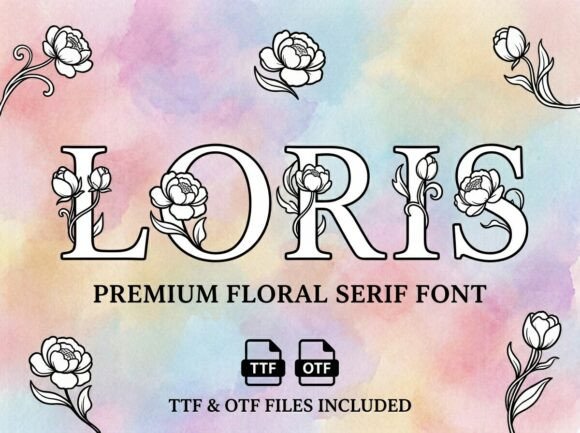
Loris is an all-caps typeface with a distinctly artistic personality. Every letterform carries weight and intention, with decorative elements that feel handcrafted rather than mechanically generated. The visual character sits somewhere between modern boldness and artistic flair—think of it as the font equivalent of a statement piece of furniture in a minimalist room. It draws the eye without overwhelming the space around it.
Where Loris Actually Works
Here's the practical reality: not every project needs a font that demands attention. But when yours does, Loris earns its place. This is a creative font built for specific moments in your design work—the headline that needs to stop someone mid-scroll, the logo that has to communicate personality in under two seconds, the packaging that has to stand out on a crowded shelf.
Logo design is where Loris really shines. A strong wordmark needs character, and this typeface delivers it naturally. Because every letter is designed as a visual unit, your brand name becomes almost illustrative. I've seen it work beautifully for boutique coffee roasters, independent record labels, artisan candle makers, and creative agencies—any brand that wants to signal craftsmanship and individuality.
In editorial design, Loris works well for chapter titles, pull quotes, and section headers in magazines or lookbooks. It brings energy to layouts that might otherwise feel flat. For packaging design, think about product names on labels, box fronts, or hang tags. The decorative quality adds perceived value, which matters when someone's deciding between your product and the one next to it on the shelf.
On the digital side, social media graphics benefit enormously from a bold display typeface. Instagram posts, Pinterest pins, YouTube thumbnails—these are environments where you have roughly half a second to communicate something. Loris gives your text the visual authority to compete with imagery. For web design, it's best reserved for hero sections and key callouts rather than body text, but in those moments it adds real personality to a site.
Understanding What You're Working With
Before you commit to Loris for a project, there's something important to understand: this is an all-caps display font. It includes uppercase letters only. No lowercase. That's not a limitation—it's a design decision that shapes how you use it.
All-caps typefaces work brilliantly in short, high-impact contexts. Think headlines, logos, monograms, and decorative initials. They create a sense of uniformity and strength because every letter occupies the same vertical space. But they're not suited for body copy, long paragraphs, or anywhere readability over extended reading matters. If you need a serif font or sans serif font for running text, pair Loris with something more restrained. A clean sans serif like Montserrat or a classic serif like Playfair Display creates a natural contrast that lets Loris do its job without competing.
You'll receive both OTF and TTF files, covering you across professional design software and everyday applications. The OTF format is your go-to for tools like Adobe Illustrator, InDesign, and Affinity Designer. The TTF ensures compatibility if you're working in more basic environments or need the font installed across different operating systems.
Choosing the Right Moment for Loris
Not every project calls for a font with this much personality, and recognizing that is part of good design judgment. Ask yourself a few questions. Does this project need visual energy? Is the text short enough that an all-caps treatment won't tire the reader? Does the brand or content have a creative, artisan, or bold identity? If you're answering yes, Loris is worth testing.
For brand identity work, consider whether the typeface matches the tone you're building. A law firm probably isn't the right fit. A streetwear brand, a craft brewery, a photography studio, a music festival—these are contexts where Loris feels authentic rather than forced.
Testing Font Pairings and Building Consistency
Good font pairing is about contrast and hierarchy. Use Loris where you need impact—headlines, titles, key phrases—and support it with a complementary typeface for everything else. The pairing should feel intentional, not accidental. Try setting a mockup with your headline in Loris and your body text in two or three different options. Step back and look at the overall composition. The right pairing will feel balanced, with each font playing a clear role.
Consistency matters across every touchpoint. If Loris appears on your packaging, consider carrying it into your social media graphics, website headers, and printed materials. A cohesive visual language builds recognition. People start to associate that distinctive lettering with your brand before they even read the words.
The Practical Side of a Commercial Font
Loris is a commercial font, which means you're investing in a professional design asset with proper licensing. That matters for client work, products you sell, and any commercial application. The files you receive cover standard use cases, but always review the license details to make sure your specific project is covered—especially if you're embedding fonts in apps, software, or digital products.
Think of this purchase the way you'd think about any tool in your creative kit. A quality display font saves you time, elevates your output, and gives your work a level of polish that generic free fonts rarely achieve. For designers, it's an asset you'll reach for repeatedly. For entrepreneurs and small business owners, it's a relatively small investment that can meaningfully shape how your brand is perceived.
The honest truth about modern typography