Titan Font: Bold Display Typography for High-Impact Branding
In a crowded marketplace, the first impression isn't just visual—it's visceral. A brand has a fraction of a second to communicate strength, reliability, and appeal before a customer scrolls past or walks away. While many elements contribute to a brand's identity, typography is the voice of the design. Choosing the right typeface is not merely an aesthetic decision; it is a strategic business move. For brands that need to command attention immediately, relying on standard, lightweight fonts often results in being overlooked. This is where heavy, high-impact display fonts enter the conversation, serving as the foundation for logos, packaging, and marketing materials that refuse to blend into the background.
The Anatomy of a High-Impact Typeface
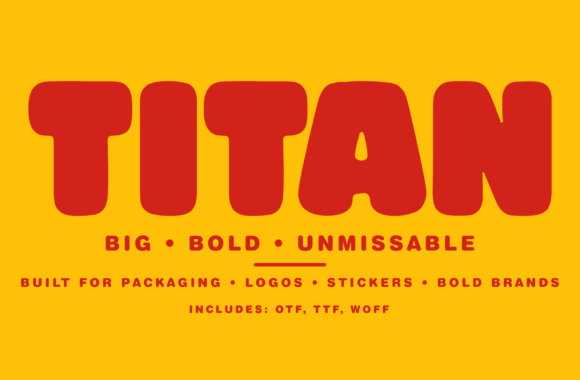
Titan is designed specifically to fill the visual space with authority. As a heavy display typeface, it prioritizes presence over subtlety. The defining characteristics of Titan lie in its exaggerated weight and rounded letterforms. Unlike sharp, aggressive geometric fonts that can sometimes feel cold or inaccessible, Titan utilizes soft curves to balance its massive footprint. This creates a visual personality that is both strong and approachable—a rare combination in modern typography. The "rounded" quality refers to the terminals and joints of the letters, which are smoothed out rather than cut sharp. This design choice softens the visual impact, making the font feel friendlier and more modern, which is essential for consumer-facing products.
From a technical standpoint, a font like Titan functions as a display font. In typography terminology, display fonts are designed for use at large sizes, such as headers, titles, and logos, rather than for long blocks of body copy. Because of the thick strokes (often referred to as "ultra-bold" or "heavy"), Titan commands the hierarchy of a page. It naturally draws the eye, making it an effective tool for establishing visual hierarchy. When a designer pairs a heavy typeface like Titan with a clean sans serif font or a simple serif font for body text, the contrast creates a dynamic layout that is easy to navigate. The Titan font does the heavy lifting of grabbing attention, while the secondary font delivers the detailed information.
Strategic Applications: From Packaging to Digital Screens
The utility of a premium font is measured by its versatility across different mediums. Titan is engineered to perform well in both digital and print environments, which is a critical requirement for modern brands that exist across multiple touchpoints. In the realm of packaging design, legibility is paramount. A product on a shelf has to compete with dozens of competitors. Titan’s high x-height and thick stroke width ensure that the product name is readable from a distance, even in low-contrast lighting conditions. This makes it an excellent candidate for the food industry, cosmetics, and supplements, where shelf presence directly correlates to sales velocity.
Beyond the shelf, Titan serves as a robust foundation for logo design. A logo built on a heavy typeface conveys stability and confidence. Because the letterforms are distinct and bold, they scale well down to smaller sizes, such as favicon or mobile app icons, without losing their essential shape. However, designers should test the font at various sizes during the proofing stage to ensure that the counters (the enclosed spaces within letters like 'o' or 'e') remain open and do not fill in when printed on textured materials like cardboard or kraft paper.
For social media graphics and web design, the font’s personality shines in headlines and call-to-action buttons. In the fast-scrolling environment of social feeds, a bold, rounded typeface cuts through the noise. It is particularly effective for streetwear branding, kids' products, and fitness apparel, where the aesthetic leans toward the energetic and modern. The font’s style suggests a brand that is contemporary, user-friendly, and confident—traits that help convert passive viewers into active customers.
Practical Guide to Integrating Titan into Your Workflow
Adopting a new typeface into a design system requires more than just installation; it requires evaluation. For designers and brand owners considering Titan, the first step is assessing the "voice" of the project. Titan speaks the language of modernity and strength. If a project requires a delicate, historic, or overly formal tone—such as a law firm’s letterhead or a vintage wedding invitation—a heavy display font may not be the right fit. However, for branding that aims to feel accessible, robust, and energetic, Titan is a strong contender.
One of the most practical aspects of working with a creative font like Titan is managing font pairing. Because Titan is so visually dominant, it should rarely be paired with another complex or decorative font. Doing so creates visual competition and makes the design difficult to read. The best practice is to pair Titan with a neutral sans serif or a simple serif typeface. For example, using Titan for the main headline and a font like Roboto, Open Sans, or a clean serif like Merriweather for the body text creates a professional, balanced aesthetic. This contrast allows the display font to do its job—capture attention—while the body text provides clarity.
When evaluating the font for commercial use, it is important to review the included file formats and licensing. A professional commercial font typically comes in OTF (OpenType), TTF (TrueType), and WOFF/WOFF2 (Web Open Font Format) files. This variety ensures the font can be used across Adobe Creative Suite for print design, as well as CSS for web design. Always verify the license to ensure it covers your specific usage, whether that is for a single client project, a series of merchandise, or unlimited commercial distribution.
Enhancing Brand Identity and Audience Engagement
Typography is a silent ambassador for a brand. The choice of a typeface influences how an audience perceives the quality and personality of a product before they even read the words. Research in visual marketing suggests that fonts with rounded edges are often perceived as friendlier and more innovative, while angular fonts are seen as more rigid and traditional. By utilizing Titan, a brand leverages the psychology of modern typography to appear approachable yet powerful.
Consistency is another pillar of strong brand identity. When a brand uses a distinct font like Titan across its packaging, website headers, social media posts, and editorial design assets, it builds a cohesive visual language. This repetition aids in brand recognition; customers begin to associate the specific shape of the letters with the brand's products and values. Over time, this visual consistency builds trust and professionalism, signaling to the customer that the brand is established and reliable.
Ultimately, Titan is more than just a collection of vector paths; it is a design asset. It provides a solution for the common challenge of standing out in a saturated market. Whether you are a small business owner designing your own labels, a marketer creating campaign assets, or a designer building a comprehensive brand system, having a reliable, bold display font in your toolkit is invaluable. It allows for the creation of designs that are not only visually appealing but also strategically engineered to capture and hold attention.