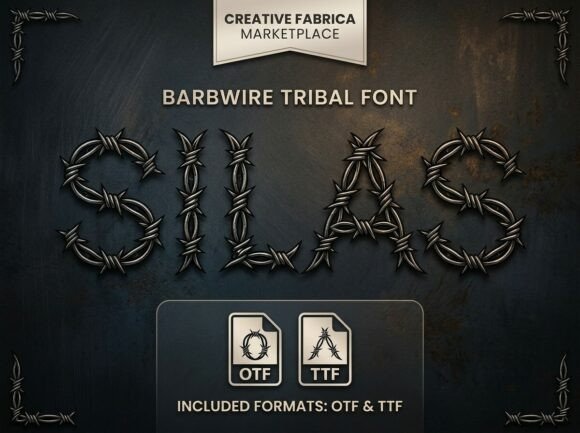
Silas: The Barbwire Tribal Font That Bites
When Your Design Needs an Edge, Not a Polish
There’s a specific moment in a project where a clean sans serif font or an elegant script font just won’t cut it. You’re designing for a concept that needs to feel raw, powerful, and unapologetically bold. This is the domain of Silas, a premium font that doesn’t just sit on a page—it attacks it. Silas is a display font meticulously constructed from the visual language of twisted metal wire and sharp thorns. It’s not merely a typeface; it’s a texture, an attitude, and a direct statement of intensity.
Forget the soft edges of a handwritten font or the structured order of a traditional serif font. Silas operates in the realm of industrial grit and survivalist aesthetics. Each character is built with a deliberate, aggressive detail, giving text a tangible, almost three-dimensional quality that’s rare in modern typography. This makes it a standout design asset for projects that need to communicate resilience, rebellion, or a high-stakes environment. It’s a font that doesn’t whisper; it roars.
Finding the Right Arena for Sharp Edges
The true value of a creative font like Silas is revealed in its application. It’s not a workhorse for body copy—its strength is in high-impact headlines and branding moments. Imagine it stamped across the lineup poster for an underground music festival. The thorny letterforms instantly set a tone of raw energy and anti-mainstream appeal, perfectly matching the event's vibe. For independent streetwear labels, Silas can become the cornerstone of a brand identity, giving logo designs and garment tags a signature toughness that resonates with a niche audience.
Consider its role in other domains. Automotive decals and garage branding benefit from its implied connection to machinery and ruggedness. In editorial design, it can be used for chapter titles or feature headlines in magazines covering extreme sports, survival gear, or gritty urban culture. For social media graphics, particularly headers or story banners for certain podcasts, gaming channels, or action film promotions, Silas creates an instant visual hook that stops the scroll. It’s a specialized tool, and using it correctly can elevate a project from ordinary to unforgettable.
Practical Guidance: Using Silas with Intent
Adopting a font with such a strong personality requires a strategist's eye. Here’s how to approach it:
- Evaluate Project Fit: Silas thrives in contexts that celebrate edginess, strength, or a "grunge-survival" narrative. It would clash with a luxury spa's delicate branding or a children's educational platform. Always ask: does the core message of this project align with the font's aggressive texture?
- Master Font Pairing: This is critical. Never pair Silas with another highly stylized font. Its power comes from contrast. Use it for your primary headline, then balance it with a clean, highly legible sans serif font for subheadings or body text. A neutral sans serif acts as a visual "rest," allowing Silas's details to shine without overwhelming the viewer.
- Test Readability: At small sizes or in long passages, the intricate details of Silas can merge, reducing legibility. Always test your headline at the intended size. It’s designed for short, impactful bursts of text—a band name, a one-word title, a call to action.
- Review Included Styles: A robust commercial font like Silas often comes with multiple styles—regular, bold, or distressed variants. Explore these options. A slightly less textured version might work better for certain applications while retaining the core aesthetic.
- Understand Licensing: For any commercial project—from client work to merchandise—ensure you have the correct license. This protects both you and the font creator and is a mark of professional practice.
Beyond the Aesthetic: Strategic Brand Perception
Typography is a silent ambassador for your brand. Choosing Silas isn’t just a visual decision; it’s a strategic one that influences perception. Consistently using this display font in your marketing materials can build instant recognition within your target audience. It tells them your brand is fearless, direct, and operates outside conventional boundaries. This can foster a stronger, more tribal connection with customers who identify with that ethos.
However, this comes with a responsibility to maintain consistency. Using Silas sporadically or alongside conflicting design elements can dilute its impact and confuse your audience. It should be a deliberate, sustained part of your visual language. When integrated thoughtfully, it becomes more than a design asset; it becomes a core component of your brand identity, communicating professionalism through its intentional, curated use. In a crowded digital landscape, that kind of distinct, uncompromising voice is what cuts through the noise.